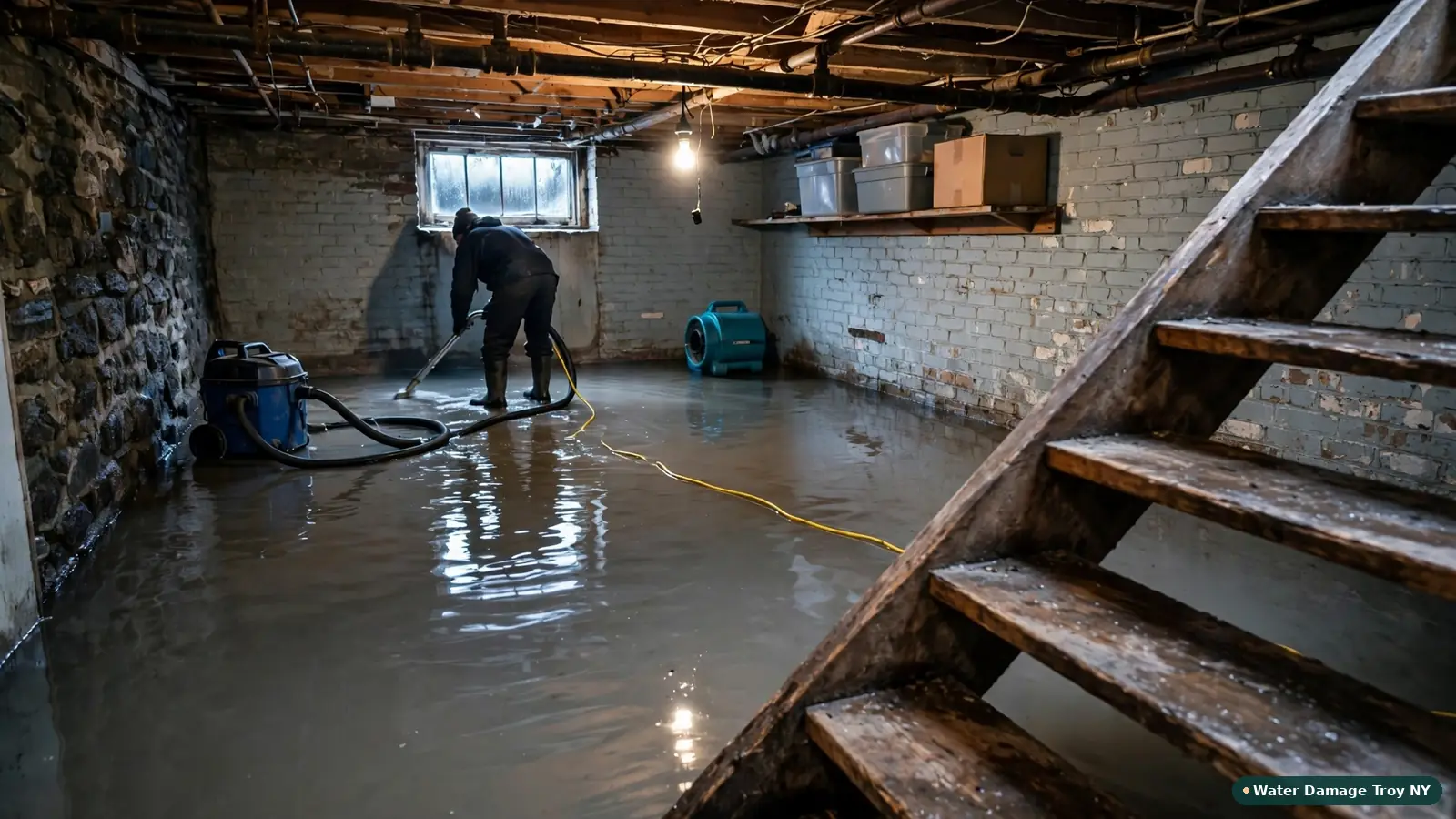
Flooded Basement Cleanup in Troy, NY
Flooded basement cleanup in Troy, NY takes more than a pump and a fan. Fieldstone and block foundations, floor drains tied to aging sewer lines and steep hillside runoff all push water below grade here. Our crew pumps out the water, removes what cannot be saved, disinfects every surface and dries your basement to a measured standard, any hour of the day.
Why Basements in Troy, NY Flood So Often
Basement flooding is the most common water damage call we get in Troy, and the reasons are baked into the city itself.
Old foundations. Many homes in Lansingburgh, Central Troy, Little Italy and South Troy sit on fieldstone or rubble foundations laid with lime mortar. Over a century or more, that mortar washes out, and water finds its way through every gap during heavy rain.
Hillside runoff. Troy climbs steeply from the Hudson up toward the Eastside, Pawling Avenue and Prospect Park. Water races downhill during storms and collects against foundations. Local news has covered South Troy homeowners near St. Vincent Avenue who say their basements take on water with nearly every rain.
River and creek water. Homes in the lower parts of the city, near the Hudson and along the Poesten Kill and Wynants Kill, can see groundwater rise when those waterways run high.
Snowmelt. March and April thaws send months of snow into the ground at once, often while the soil is still frozen just below the surface, so water runs sideways into basements.
Older drain lines. Floor drains connected to aging sewer laterals can back up when heavy rain overloads the system.
Equipment failures. Sump pumps quit during power outages, and water heaters in basements rust through without warning.
What Should You Do If Your Basement Floods in Troy?
Quick answer: stay out of the water if it is near outlets, the electrical panel or appliances, stop the source if you can, take photos, move belongings up and out of reach, and call a basement cleanup crew right away. Fast pumping and drying keeps water from soaking into foundation walls, framing and the floor above.
A few more things that help in Troy specifically:
- If you smell gas or the water is touching your furnace or boiler, leave the basement and call the utility.
- If water is coming up through a floor drain, avoid running sinks, showers, the dishwasher or washer until we arrive. Every gallon you send down may come right back up.
- If water is coming through the walls after heavy rain or snowmelt, check that downspouts are not dumping right at the foundation.
- Do not try to pump out a deep flood all at once while the ground outside is soaked. Let a crew decide how fast it is safe to pump.
Our Flooded Basement Cleanup Process in Troy
Stage 1: Safety check. We confirm power to the basement is off or safe, look for gas appliance issues and check stairs and floors before entering.
Stage 2: Source and category. We find where the water came from and whether it is clean, gray or black water, because that decides what can be saved.
Stage 3: Pump-out. Submersible pumps remove deep water fast. When the soil outside is saturated, we pump in stages to protect the foundation.
Stage 4: Extraction and debris removal. Truck-mounted extraction pulls water from carpet and hard floors. Mud, silt and ruined materials are bagged and hauled out.
Stage 5: Cleaning and disinfection. Floors, walls, framing and the bottoms of stairs are cleaned and treated with antimicrobial products.
Stage 6: Drying. Dehumidifiers built for cool basements and air movers aimed at walls and framing run until readings hit their dry goal.
Stage 7: Final check and rebuild. We verify the space is dry, then rebuild drywall, flooring and trim if needed.
Is the Water in Your Troy Basement Clean, Gray or Black?
The source of the water changes how we clean up, so it is one of the first things we figure out.
Clean water (Category 1) comes from a supply line, water heater or rain coming straight through a window well. It is the easiest to clean and dry, but it can turn into gray water if it sits for a day or two in a warm basement.
Gray water (Category 2) comes from a washing machine discharge, dishwasher or sump pit. It carries soaps, organics and some bacteria. Porous materials it touches usually need more aggressive cleaning or removal.
Black water (Category 3) includes sewage backing up through a floor drain, and outside flood water from the Hudson, the Poesten Kill, the Wynants Kill or street runoff. It carries bacteria and other contaminants, so carpet, pad, drywall and insulation it touches are removed, and every hard surface is cleaned and disinfected.
What We Can Save and What Has to Go in a Troy Basement
- Concrete floors and stone or block walls: cleaned, disinfected and dried in place.
- Wood framing and sill plates: dried in place when caught early; treated with antimicrobial.
- Drywall: often saved after a clean-water leak; flood-cut a couple of feet up after sewer or flood water.
- Carpet pad: almost always replaced, because it acts like a sponge.
- Carpet: sometimes saved after clean water; removed after sewer or flood water.
- Fiberglass insulation in walls or between joists: removed when soaked.
- Furnace, boiler and water heater: have them checked by your heating contractor or plumber before restarting if water reached the burners or controls.
- Boxes, papers and photos: moved out fast. Some documents and photos can be saved with specialized drying.
We walk you through these decisions before anything is removed, and we photograph every item for your claim.
Old Stone Cellars vs. Finished Basements in Troy
Troy basements come in two very different flavors, and we clean them differently.
The old stone or brick cellar is common in Lansingburgh, Central Troy, Little Italy and South Troy. These spaces usually have a mix of concrete, stone and sometimes dirt floor, exposed joists and very little finish material. Cleanup focuses on removing mud and debris, disinfecting the surfaces, drying the masonry and protecting the sill plates and floor joists above. Stone walls take longer to dry, and we use dehumidifiers that keep working in cool, damp air.
The finished basement is more common in newer homes around Sycaway, the Eastside and nearby towns like Brunswick and North Greenbush. Here, the work is about saving what we can: drying framing behind drywall, deciding whether carpet can be saved, checking under vinyl plank and laminate, and protecting built-ins. We cut drywall only as high as the readings say, often a clean line a couple of feet up, so rebuilding is quicker.
How to Prevent the Next Basement Flood in Your Troy Home
Once your basement is dry, a few changes can make the next storm a non-event:
- Extend downspouts at least several feet from the foundation. Many Troy homes still dump roof water right at the wall.
- Check grading. Soil should slope away from the house, which matters even more on hillside lots.
- Add a battery backup to your sump pump so a storm outage does not shut it off when you need it most.
- Ask a plumber about a backwater valve if your floor drain has backed up before.
- Cover or seal window wells and keep them clear of leaves.
- Run a dehumidifier set around 50 percent from late spring through early fall.
- Store boxes on plastic shelving, not on the floor, and use plastic bins instead of cardboard.
- Put inexpensive water alarms near the water heater, washer and sump pit.
How to Lower the Odds of Another Flooded Basement in Troy
Many Troy basements will always be a little damp, but most repeat floods can be cut down with a few practical fixes:
- Extend downspouts several feet from the foundation, especially on hillside lots where runoff races downhill
- Regrade soil so it slopes away from the house instead of toward it
- Add a battery backup to the sump pump and a high-water alarm in the pit
- Ask a plumber about a backwater valve if the floor drain has backed up during heavy rain
- Seal obvious gaps in fieldstone or block walls and around pipe penetrations
- Keep stored items on shelves or in plastic bins, never in cardboard on the floor
- Run a dehumidifier in summer to keep basement humidity under control
After we dry your basement, Water Damage Troy NY walks you through which of these steps would make the most difference in your specific home, based on where the water actually came in. sump pump failure cleanup
Related Basement Water Services in Troy
Flooded Basement Cleanup in Troy, NY at a Glance
Short answer: a flooded basement in Troy should be pumped out the same day, then dried with dehumidifiers until walls and floor read dry. Stone and brick foundations common in Lansingburgh and South Troy hold moisture, so drying often takes longer than in newer homes.
- Top causes: spring snowmelt, sump pump failure, sewer backup through floor drains and cracked foundation walls.
- Safety first: do not step into water that touches outlets, a furnace or a water heater.
- What gets removed: wet carpet and pad, cardboard, soaked drywall and insulation.
- What can often stay: concrete, fieldstone, framing and many finishes once dried.
- Drying time: usually three to five days; longer for thick masonry.
- Prevention: sump backup power, downspout extensions and a working floor drain check valve.
Water Damage Troy NY also checks the water source, because basement water from a sewer needs sewage backup cleanup, not just drying.
Flooded Basement FAQs for Troy, NY
Answers to the basement questions Troy homeowners ask us most.
How long does it take to dry a flooded basement in Troy?
Most basements dry in three to five days after extraction. Stone and brick foundations, thick concrete and cold winter temperatures can stretch that to a week. We take readings daily and only pull equipment once walls, floors and framing reach their dry goal.
Does homeowners insurance cover a flooded basement in New York?
It depends on where the water came from. A sudden pipe or water heater failure is commonly covered. Sewer or drain backups often need a separate backup endorsement on your policy. Groundwater and surface flooding usually fall under flood insurance, not a standard homeowners policy. Call your agent early and ask; we provide the photos and moisture logs either way.
Should I pump out my flooded basement myself?
For an inch or two of clean water, a wet/dry vacuum can help. For anything deeper, sewage, or water touching outlets, call a crew. And if the ground outside is still saturated after a big storm or snowmelt, pumping a deep basement all at once can let outside water pressure push on the foundation walls. We pump in stages when conditions call for it.
Will my basement still smell musty after it dries?
It should not, if it was cleaned and dried properly. A lingering musty smell usually means something is still wet: a box of papers, the bottom of a stud wall, carpet pad or the mortar joints in a stone wall. We do a final moisture check before we leave so odor does not come back the first humid week of summer.
Can you clean a Troy basement that has a dirt floor or crawl area?
Yes. Many older Troy homes have a section of dirt floor or a low crawl area off the main cellar. We extract or pump what we can, remove soaked debris, treat the soil surface and dry the surrounding framing and sill plates. We can also lay a temporary vapor barrier to slow moisture coming up from the ground.
Get Your Troy Basement Pumped Out and Dried Today
Water in the basement gets worse by the hour. It soaks into foundation walls, rots framing and feeds mold that spreads into the rest of the house. Our Troy crew can be pumping, cleaning and drying your basement today.
Basements near the Hudson River in South Troy and along the Poesten Kill sit close to the water table, and many have fieldstone or rubble walls that let water in at dozens of points. Water Damage Troy NY pumps them out, dries the masonry and framing, and checks the floor drain and sump so you know whether the water came from groundwater, a backed-up combined sewer or a failed pump.
Water Damage Troy NY serves Troy 12180, 12182 and nearby Brunswick, Wynantskill, North Greenbush, Watervliet and Cohoes.